
Nature makes this look effortless. Ask a model to paint it from scratch and the reflection is where things quietly fall apart.
Nature makes this look effortless. Ask a model to paint it from scratch and the reflection is where things quietly fall apart.
Water, glass, and mirrors that track the scene instead of dissolving into soup
Put your subject in front of a mirror and watch the whole image quietly lose its mind. The reflection shows a different face. Or a second head. Or a smeared ghost that does not match the person standing in front of it. Do it near a lake and the mountains in the water bend in ways real water never bends. Set the scene on a wet city street and the puddles reflect buildings that are not in the shot.
Reflections are one of the last honestly hard problems in AI art, and it is worth understanding why before you try to fix it. Once you know what the model is actually doing, the prompt moves make sense and you stop fighting the tool.
This one is about reflective and transparent surfaces: still water, rippled water, glass, wet pavement, and the dreaded mirror. What breaks, why it breaks, and how to get results that hold together.
Here is the core of it. A diffusion model does not build a 3D scene and then trace light bouncing through it. There is no room, no glass, no rays. It paints a flat field of pixels that has learned to look like the kinds of pictures it was trained on. A real reflection is a physics calculation, and the model is doing pattern-matching instead of physics.
That gap does not matter much for a face or a tree, because the model has seen millions of faces and trees and knows what plausible ones look like. A mirror is different, because a mirror has to show a specific, correct, geometry-locked copy of whatever is in front of it, from a flipped point of view, at the right distance, with the right parts hidden. The model has no mechanism to compute that. It just paints something mirror-shaped and fills it with something reflection-flavored, and the two halves do not have to agree.
This is not a small quirk of one app. Across the big generators, a person facing a mirror routinely comes back with a reflection wearing a different expression, holding a different pose, or dissolving into an abstract blur. It is consistent enough that researchers have built entire projects and training datasets specifically to teach models faithful mirror reflections, leaning on depth information and targeted inpainting to force the geometry to line up. Useful to know that fix is coming. Also useful to know it is not reliably in your hands today, so you plan around it.
The one-line takeaway: the model is great at surfaces that only need to look plausible and bad at surfaces that need to be provably correct. Water reflecting a sky is forgiving. A mirror reflecting a named person is not. Pick your battles accordingly.
You do not need optics homework, but two ideas will make your prompts smarter, because they tell you what a believable reflection is supposed to do.
One: reflections are flipped and offset, not pasted. A reflection is a mirror image along the surface, and it comes from the viewer's eye line, not the object's. That is why a mountain reflected in a lake sits directly below the mountain and reads as an upside-down twin, while a reflection on a tilted shop window slides off to the side. If a reflection in your image is an exact, un-flipped duplicate stuck next to the object, that is the tell that it is fake, and it is the single most common way AI reflections look wrong.
Two: the Fresnel effect, which is simpler than it sounds. Surfaces get more reflective at a shallow, grazing angle and less reflective when you look straight down into them. Look at a lake from across its surface and it is a bright mirror. Look straight down into the same lake and you see the rocks on the bottom. This is why a low camera angle near water gives you those gorgeous full reflections, and a top-down angle gives you a see-through pond. When you want a strong reflection, prompt a low angle. When you want to see into the water, go overhead. The lighting article we did on golden hour and directional light stacks nicely here, because low sun plus a low angle over water is where reflections look their best.
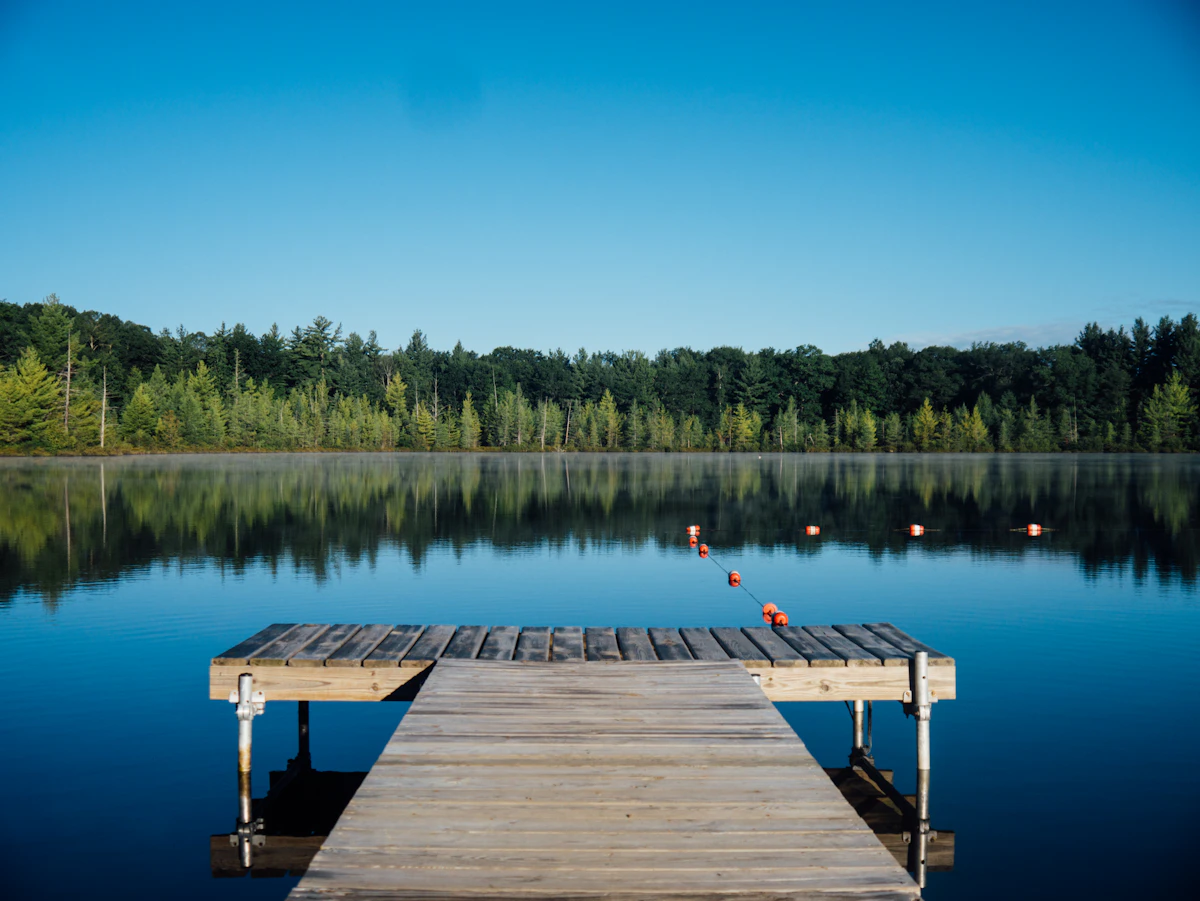
Dead-calm water is a near-perfect mirror. This is the easy case, and it is the one to prompt for when you want reflections that behave.
Water is the friendliest reflective surface to prompt because it forgives small errors, but you get very different results depending on how calm you say it is, and that single word changes everything.
Still water behaves like a mirror. Terms like "glassy," "mirror-still," "perfectly calm reflection," and "mirror-like surface" push the model toward that clean, symmetrical, upside-down twin. This is the most reliable reflection you can ask for, because the model has seen countless calm-lake photos and knows the shape of the answer.
Broken water scatters the reflection into streaks and shards, and this is secretly the easier win for realism. Ripples, wind chop, and rain mean the reflection does not have to be geometrically perfect, because it is supposed to be smeared and stretched. The model's sloppiness becomes indistinguishable from real physics. Words like "rippling reflection," "wind-rippled water," "wet reflections scattered on the surface," and "shimmering broken reflection" hide a multitude of sins.

Rain and ripples are your friend. A broken reflection does not have to be correct, only pretty, and the model is very good at pretty.
So the honest strategy is this: when the reflection is the star, prompt still water for a clean mirror. When you just want atmosphere and the reflection is supporting cast, prompt broken water and let the chaos work for you. Rain-slicked streets, neon puddles, and shimmering harbors are popular for exactly this reason. They are gorgeous and they are cheap, because a reflection nobody can check is a reflection that cannot look wrong.
Reflectivity is a material property, so it lives in the same part of the prompt as the rest of your surface description. If you have read the materials and texture guide, this is the same muscle: you are telling the model how light behaves on a surface. The words below are the ones that actually move the needle.
| Surface | Prompt language that works | Watch out for |
|---|---|---|
| Calm water | glassy, mirror-still, perfectly calm, mirror reflection of the sky | Overhead angles kill the reflection; keep the camera low |
| Moving water | rippling reflection, wind-rippled, shimmering broken reflection, wet shimmer | Too much chop and the reflection disappears entirely |
| Wet pavement | rain-slicked street, reflective wet asphalt, neon reflections on wet ground | Reflected signage often comes out as gibberish text |
| Glass and windows | reflective glass, subtle window reflection, glare, partial transparency | The model flip-flops between transparent and mirrored; say which |
| Polished surfaces | polished marble floor, glossy tabletop, soft reflection underneath | Full reflections read as fake; ask for a soft, faint one |
| Actual mirror | mirror behind, reflection in the mirror, over-the-shoulder view | Expect the reflection to disagree with the subject; plan to fix it |
Two practical notes. Reflected text is almost always garbage, so if a wet street is throwing neon signs into a puddle, either keep the reflected signage small and out of focus or crop it out. And glass genuinely confuses models, because a window can be transparent, mirrored, or both at once depending on the light. Pick one and say it. "Looking through the glass" and "reflection on the glass" are two different requests, and if you do not choose, the model will average them into a murky half-and-half.
Say you got a beautiful portrait and the only problem is the mirror behind her shoulder showing a stranger. Do not throw the whole image away and gamble on a reroll. The subject is already good. You only need to repair one region, and that is exactly what inpainting is for.
Mask just the reflection, keep the rest of the image locked, and regenerate that patch with a tighter, quieter prompt that describes what the reflection should contain: the back of her head, her hair, the same jacket, soft and slightly darker. Lower the denoising a touch so the fix blends into the surrounding surface instead of inventing a whole new scene. It usually takes a few tries, but you are gambling with one small square instead of the entire picture. We walked through the whole masking workflow in the inpainting guide, and reflections are one of its best uses.
The other repair route, for anyone working in a node setup, is depth or reference conditioning. Feeding the model a depth map or a reference of the scene gives it the geometric spine it was missing, and that is precisely the trick the reflection researchers lean on. It is more setup than a casual prompt, but if you are chasing a specific, correct reflection rather than a pretty vague one, it is the difference between hoping and directing. The same conditioning mindset shows up in the ControlNet guide.
The cheat that never fails: if a reflection keeps fighting you and it is not the point of the picture, dodge it. Angle the camera so the mirror is out of frame, roughen the water so the reflection is a shimmer instead of a copy, or dim the surface so the reflection is a faint suggestion rather than a second scene that has to be correct. The best-looking AI reflections are often the ones the model was never asked to fully commit to.
Reflective surfaces are hard because the model paints plausible pixels instead of tracing real light, so anything that has to be provably correct, above all a mirror, is where it stumbles. Lean on the two ideas that matter: reflections are flipped and offset, and surfaces mirror more at a low grazing angle than from overhead. Prompt still water when you want a clean mirror and broken water when you just want atmosphere, because a rippled reflection cannot look wrong. Say whether glass is transparent or mirrored instead of letting the model guess. And when a reflection breaks in an otherwise great image, inpaint the one bad patch rather than rerolling the whole thing, or simply frame the trouble out.
Reflections reward the artist who works with the tool's grain instead of against it. Give the model the easy version of the problem and it will hand you something that genuinely glows.