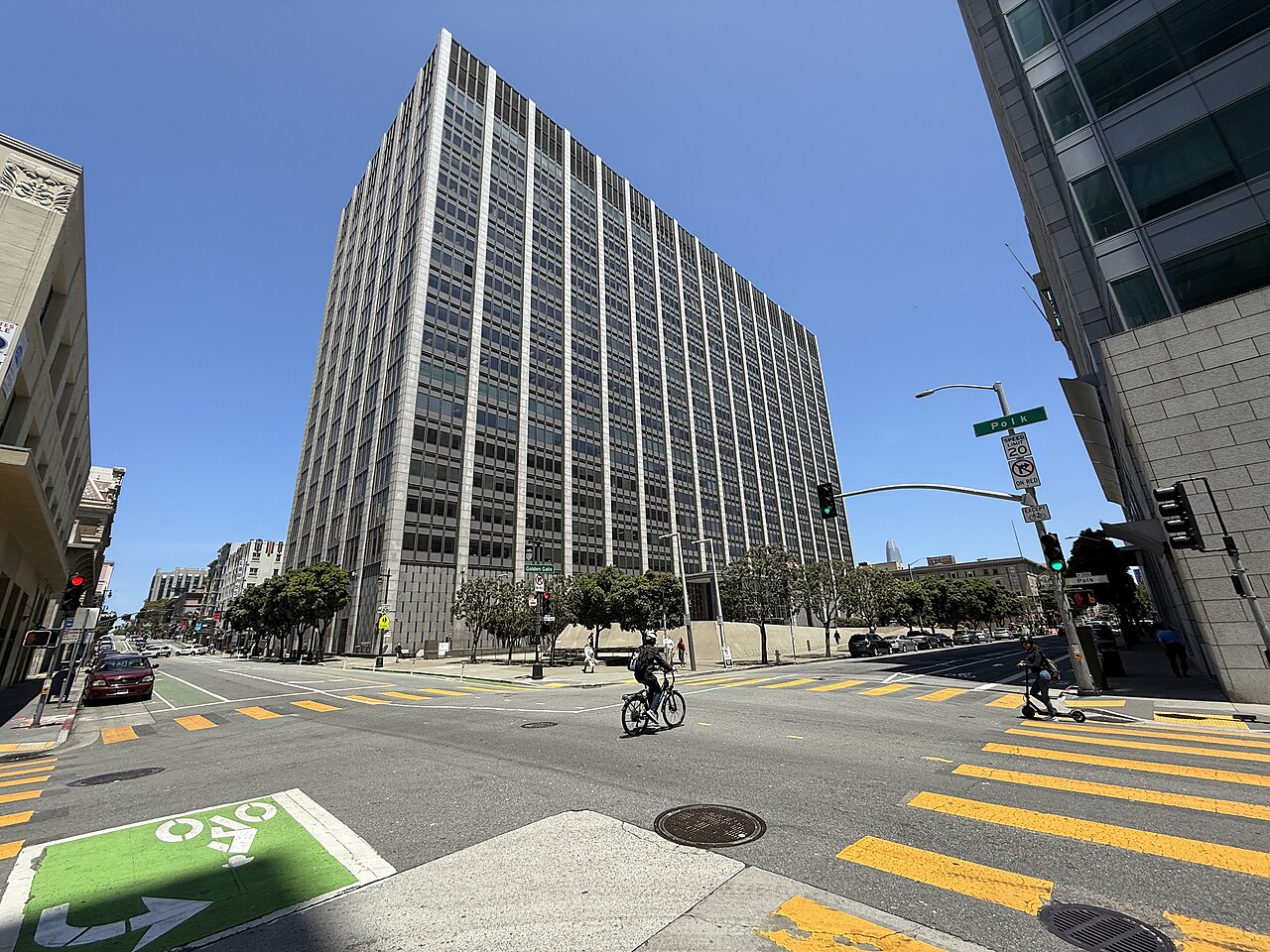
The Phillip Burton Federal Building and United States Courthouse, San Francisco. Photo: Marincyclist, CC BY SA 4.0, via Wikimedia Commons.
The Phillip Burton Federal Building and United States Courthouse, San Francisco. Photo: Marincyclist, CC BY SA 4.0, via Wikimedia Commons.
The date got repeated so often it stopped being checked. One sentence in a January filing settles it, and the discovery numbers in the same filing are more interesting than the trial that never started.
If you make AI images, you probably saw it go by last week. The first jury trial over whether training an image model on artists’ work is infringement, Andersen v. Stability AI, starting September 8, 2026 in San Francisco. Twelve ordinary people deciding the legal status of the tools a lot of this site is made with. A law firm blog post dated September 6 ran the headline “The First Jury Trial Over AI Image Training Begins This Week.”
It did not begin that week. Nobody was sworn in. The date everyone kept repeating had been dead for a long time, and the court record says so in one plain sentence.
September 8, 2026 was real once. It was the trial date in the early case schedule, and it got quoted in explainers and trackers for so long that it became a fact people stopped checking.
Then the schedule moved. The parties’ Joint Case Management Statement, filed January 13, 2026 ahead of a January 20 conference before Judge William H. Orrick, states it directly: “Trial has been set for April 5, 2027, at 8:30am.” It cites the court’s own scheduling order for that date. The same filing says the plaintiffs anticipate a 14 day trial, while the defendants say it is premature to estimate.
Current trackers agree. BakerHostetler’s AI case tracker lists the trial for April 5, 2027. So does the AI Lawsuit Tracker, which notes the schedule slipped about seven months from the old September target as discovery expanded.
So when you see a September 2026 post telling you this jury trial is underway, it is working from a calendar that stopped being true well over a year before the date arrived.
It is often still summed up as a few artists against Stability. The January filing lists eight plaintiffs: Sarah Andersen, Karla Ortiz, Grzegorz Rutkowski, Gregory Manchess, Gerald Brom, Jingna Zhang, Julia Kaye and Adam Ellis, suing for themselves and a proposed class.
And it is not just Stability. The defendants are Stability AI Ltd., Stability AI, Inc., DeviantArt, Midjourney and Runway AI. If you generate on Midjourney, you are using a defendant’s product. If you ever touched Stable Diffusion weights, same.
The plaintiffs also asked for leave on January 12, 2026 to file a Third Amended Complaint that, in their words, “supplements direct copyright infringement claims against Midjourney and DeviantArt with new evidence of additional copying uncovered in discovery.” The AI Lawsuit Tracker shows that complaint filed on February 27, 2026 and answered by the defendants on March 13.
The January statement includes a status report on document discovery for every party. It is the most concrete picture I have seen of what this fight looks like from the inside, so here it is as filed:
| Party | Documents produced | Pages | As of |
|---|---|---|---|
| Plaintiffs (all eight) | more than 24,600 | 180,368 | January 7, 2026 |
| Runway | 22,984 | 167,486 | January 13, 2026 |
| Midjourney | 4,944 | 79,257 | January 13, 2026 |
| Stability AI | 4,512 | 20,282 | January 7, 2026 |
| DeviantArt | 1,530 | 6,145 | January 7, 2026 |
Add up Midjourney, Stability and DeviantArt and you get 105,684 pages. The eight artists alone had produced 180,368. The people who say their work was taken had, at that point, handed over roughly 70 percent more paper than three of the companies accused of taking it.
The page counts are not the whole story. Midjourney reported it had substantially completed production of relevant training data, delivered on hard drives and through Google Cloud, and made source code available for inspection. Runway produced more than 60 terabytes of what it identifies as the LAION 5B data in its possession, and made source code available for every model at issue. DeviantArt said it does not possess relevant LAION training data. Stability and the plaintiffs had agreed on a format for Stability’s training data production.
That is the real work of this case. Not a jury. Hard drives, format negotiations, and discovery disputes headed to Magistrate Judge Cisneros.
Going by the January filing, the list is long. The plaintiffs anticipated moving for class certification, which the defendants said they would oppose. Both sides anticipated summary judgment motions. The AI Lawsuit Tracker notes the fair use defense has not been adjudicated and that defendants are expected to raise it after expert discovery closes.
Any one of those can change what, if anything, a jury eventually hears. A summary judgment ruling on fair use could matter more to working AI artists than the trial itself.
Honestly, for now: nothing changed on September 8, because nothing happened on September 8.
The models you use are exactly as legal or as contested as they were last month. No jury has said training is infringement. No jury has said it is fair use. If someone in your comments tells you the courts just ruled against AI art, or ruled for it, ask them which ruling, and on what date.
What is worth doing is the same boring thing I keep recommending for every part of a creator pipeline: keep records. Which tool, which model version, which date. If a ruling in 2027 draws a line between models, you will want to know which side of it your back catalog sits on.
And the next time a date gets repeated everywhere at once, pull the filing. The court record in this case was sitting in a public PDF the whole time, and it took one sentence to settle it.
Joint Case Management Statement, Andersen v. Stability AI, United States District Court for the Northern District of California, filed January 13, 2026 (public copy hosted by ChatGPT Is Eating The World); BakerHostetler, Case Tracker: Artificial Intelligence, Copyrights and Class Actions, read September 14, 2026; AI Lawsuit Tracker case page for Andersen v. Stability AI, read September 14, 2026. Photo: Phillip Burton Federal Building and United States Courthouse, San Francisco, by Marincyclist, CC BY SA 4.0, via Wikimedia Commons.