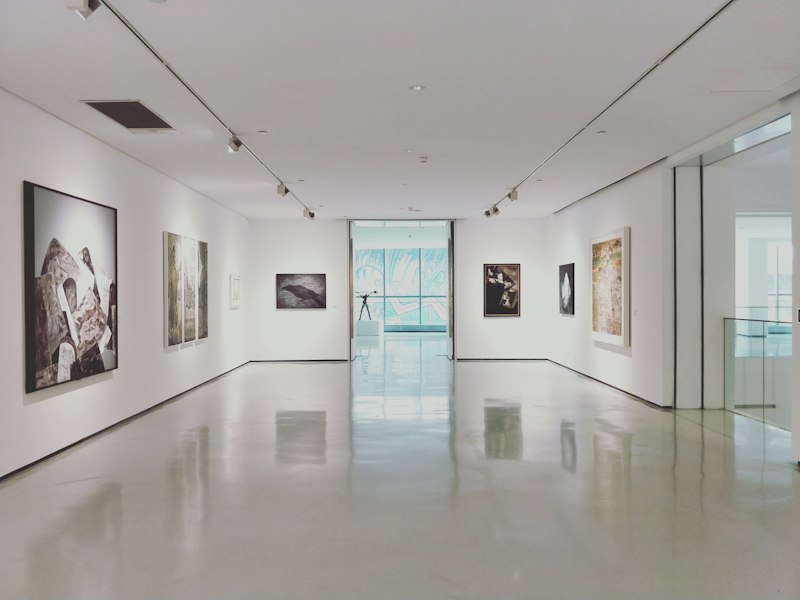
Something genuinely historic is happening right now, and I don't think enough people in the AI art community are talking about it. AI-generated art is moving off our screens and onto actual museum walls. Not as a novelty. Not tucked into a corner of a group show with an apologetic placard. Real museums, real galleries, real institutions are dedicating entire buildings and exhibitions to the art we create with algorithms, diffusion models, and generative systems.
2026 might just be the year AI art stops being a curiosity and starts being a legitimate art movement with a physical home. Let me walk you through the exhibitions that are making this happen.
This is the big one. DATALAND is opening this spring at The Grand LA, a Frank Gehry-designed complex in downtown Los Angeles, and it holds the distinction of being the world's first museum dedicated entirely to AI-generated art. Not a wing. Not a pop-up. An entire 2,320-square-meter institution with five distinct galleries, all devoted to exploring the creative potential of data and generative systems.
The museum is the brainchild of Refik Anadol and Efsun Erkilic, who founded Refik Anadol Studio over a decade ago and have exhibited their work in more than 80 cities across six continents. If you've ever seen those mesmerizing, swirling data sculptures that look like oceans of light, that's Anadol's work, and DATALAND is essentially the culmination of everything his studio has been building toward.
The centerpiece is Gallery C, the Infinity Room, an evolved version of one of Anadol's most iconic installations. Originally conceived in 2014 at UCLA, this immersive environment is a mirrored cube animated by undulating black-and-white projections that use light as a material and data as pigment. But the DATALAND version takes it further: it features AI-generated scents created by something called the Large Nature Model, and it's the first immersive environment to use World Models, an advanced generative AI that understands real-world physics and spatial dynamics.
What excites me most is the museum's Artist Residency Program, launched in partnership with Google Arts & Culture. Three selected artists will spend six months exploring new frontiers of human-machine collaboration. That's the kind of institutional support that turns a movement into a discipline.
Why it matters: DATALAND isn't just a museum. It's a statement that AI art deserves the same institutional respect as painting, sculpture, and photography. When a Frank Gehry building houses your medium, the conversation about legitimacy shifts permanently.
While DATALAND is building the future from the ground up, ARTECHOUSE in New York City is already hosting one of the most ambitious immersive AI art experiences you can walk into right now. "World of AI-magination" is a large-scale experiential digital artwork that combines generative algorithms with human creativity, and it's set inside an old boiler room beneath Chelsea Market. Yes, really.
The installation centers around a 20-minute cinematic experience split across six scenes, each one built using cutting-edge machine learning technologies including Stable Diffusion and GAN (Generative Adversarial Networks). The development pipeline integrated NVIDIA hardware and state-of-the-art generative AI tools, but it all started with human-led concept design that matured into a visual narrative.
The scenes range from "Submerge" to something called "GAN Mecca," and include the Library of Magical Portals (colossal books brimming with dreams and algorithms), the Symphony of Illusions (an ever-morphing environment), the Infinite Maze, and The Dreamer's Emporium. It sounds like something out of a fantasy novel, but it's all rendered through generative AI and projected at gallery scale.
ARTECHOUSE is open Monday through Thursday from noon to 8 PM, and Friday through Sunday from 10 AM to 9 PM. If you're in New York, this is genuinely worth the trip.
For those of you who like your AI art with a side of technical depth, the CVPR 2026 AI Art Gallery in Denver, Colorado (June 5-7, 2026) is one to watch. CVPR is one of the most prestigious computer vision and machine learning conferences in the world, and its AI Art Gallery has become a fascinating intersection of cutting-edge research and artistic expression.
What makes CVPR unique is that the artists exhibiting there often built the very models and algorithms behind their work. These aren't people using off-the-shelf tools. They're researchers who see art as a way to explore the boundaries and possibilities of their own creations. The gallery includes both on-site installations at the Music City Center and a parallel online presentation, so even if you can't make it to Denver, you can still experience the work.
Here's what I keep coming back to: for the past few years, AI art has lived almost entirely online. Instagram feeds, Twitter threads, Discord servers, maybe a print you ordered from someone's Etsy shop. And that's fine. Digital art is digital. But there's something that changes when your medium gets a museum.
Photography went through this exact same journey. When it was invented, the fine art world dismissed it completely. "That's not art, that's a machine." Sound familiar? It took decades of advocacy, of photographers demanding gallery space, of institutions like MoMA eventually dedicating entire wings to photography before it was accepted as a legitimate art form. Now nobody questions whether photography belongs in a museum.
AI art is on that same trajectory, but it's happening faster. DATALAND opening in a Frank Gehry building in downtown LA isn't a sideshow. ARTECHOUSE running a 20-minute AI cinematic experience to packed audiences in Manhattan isn't a gimmick. These are real cultural moments.
For those of us who create AI art, this is incredibly encouraging. It means the tools we use, the processes we develop, and the aesthetic sensibilities we cultivate are being recognized as genuine creative contributions. It means curators, critics, and the broader public are starting to engage with AI art on its own terms, not just as a tech demo or a controversy.
If you're an AI artist and want to be part of this wave, here are some practical steps. First, keep an eye on DATALAND's Artist Residency Program, which is specifically designed for creators working at the intersection of AI and art. Applications for the Google Arts & Culture partnership are expected to open later this year. Second, CVPR's AI Art Gallery accepts submissions from artists working with computer vision and AI, so if your work has a technical backbone, that's a natural fit.
But honestly, even if you never exhibit in a physical museum, the cultural shift these institutions represent benefits all of us. When AI art has legitimate gallery homes, the conversation moves from "is this real art?" to "what kind of art is this?" And that's a much more interesting conversation to be having.
I'll be following DATALAND's opening closely and plan to do a full walkthrough review once it opens. If you get there before me, please share your experience. This is a moment for the whole community.
Stay creative, friends.
- Clara